Lapsang Souchong has been around since the 17th century, making it one of the oldest black teas still in continuous production. The origin story goes that soldiers passing through Fujian disrupted a harvest, and the farmers — trying to salvage the season — dried their leaves quickly over pine fires. The smoked tea turned out to have a market of its own. Europeans took to it enthusiastically, and it became one of the first Chinese teas exported to the West in any quantity.
The Chinese name is Zheng Shan Xiao Zhong — "small-leaf cultivar from the right mountain." The English name is a phonetic tangle: "lapsang" from the Hokkien pronunciation of Zhengshan, "souchong" from xiao zhong. It doesn't romanize consistently by any standard, but the name stuck.
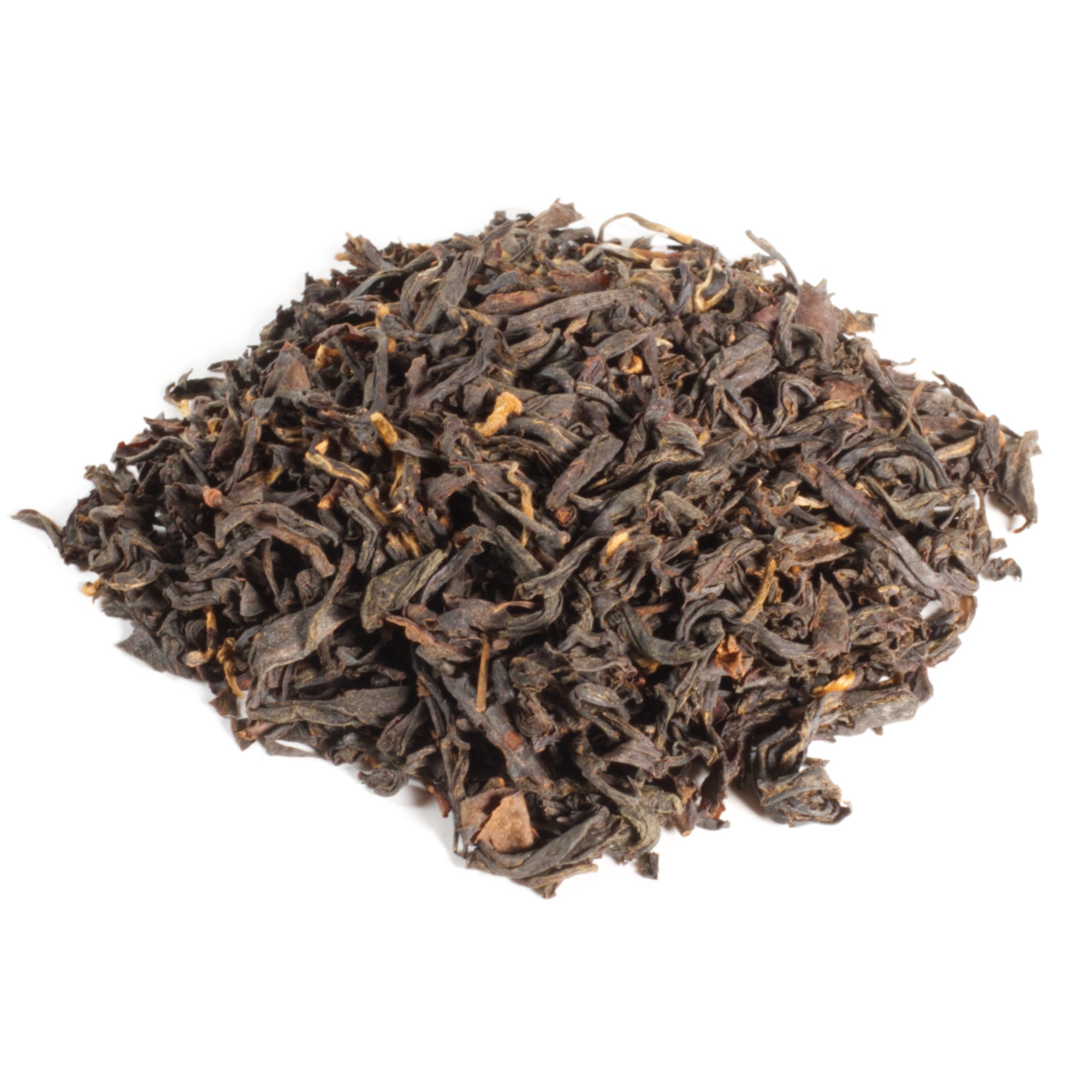
Our lot comes from Jiangxi Province, where we work with a worker-owned cooperative. The traditional production heartland is the Wuyi region of neighboring Fujian, but our source grows and smokes with the same methods: leaves are fully oxidized as standard black tea, then dried over pine fires, absorbing the smoke directly. Ours is fully committed to that process. It is not subtle Lapsang.
There's a growing category of unsmoked Zhengshan Xiao Zhong — same cultivar, same terroir, dried without smoke. Genuinely good tea. Not what we carry.
Brew at a full 210°F for 4 minutes, 1 tsp per cup. It handles extended steeping without turning bitter. Give it a brief hot-water rinse first to open the leaves. Three solid infusions are typical; the smoke doesn't abandon you on the second pass.
USDA certified organic. No artificial anything. This is a whole-leaf tea, not a flavored black.
FAQ
What does Lapsang Souchong taste like?
Campfire, pine smoke, and a black tea base — with a hint of longyan fruit underneath. The smoke is the lead note from first sip. It's bold and distinctive; nothing else in our collection tastes like it.
Is this too smoky? I've had Lapsangs that were overwhelming.
This one is fully smoked, not subtle. That said, customers who had given up on Lapsang after weak or synthetic versions often find this one exactly right — genuine pine smoke rather than a chemical approximation. Ginna searched for a year before landing here. Worth trying a sample before committing to a tin.
Does Lapsang Souchong get bitter if you over-steep it?
No. The smoke is the dominant note regardless of steep time. Gerry confirmed it: "doesn't get bitter when allowed to steep longer than recommended." Four minutes is the guide, but you have room to wander.
Is this a good everyday tea or more of an occasional thing?
Depends on who you are. Sandra brews a pot every afternoon. Nancy and her husband drink it every morning and take it when they travel. On the other side, Michael calls it great for special occasions but not his daily. It's genuinely either, and the people who make it their daily tend to be committed about it. Manimala put it well: "This is the tea that made me quit coffee."
How does this compare to your Russian Caravan?
Russian Caravan is a blend that includes Lapsang Souchong alongside Keemun and Oolong. The smoke in Russian Caravan is tamed and woven into something more complex. Lapsang Souchong is the smoke itself — direct and undiluted. If you want to know what the smoky note in Russian Caravan actually is, this is that note.
How much caffeine does Lapsang Souchong have?
About 50mg per 8oz cup, in line with our other black teas. That's roughly half a standard cup of coffee, without the spike-and-crash. The leaves re-steep well, so your second cup from the same leaves will be lighter.